
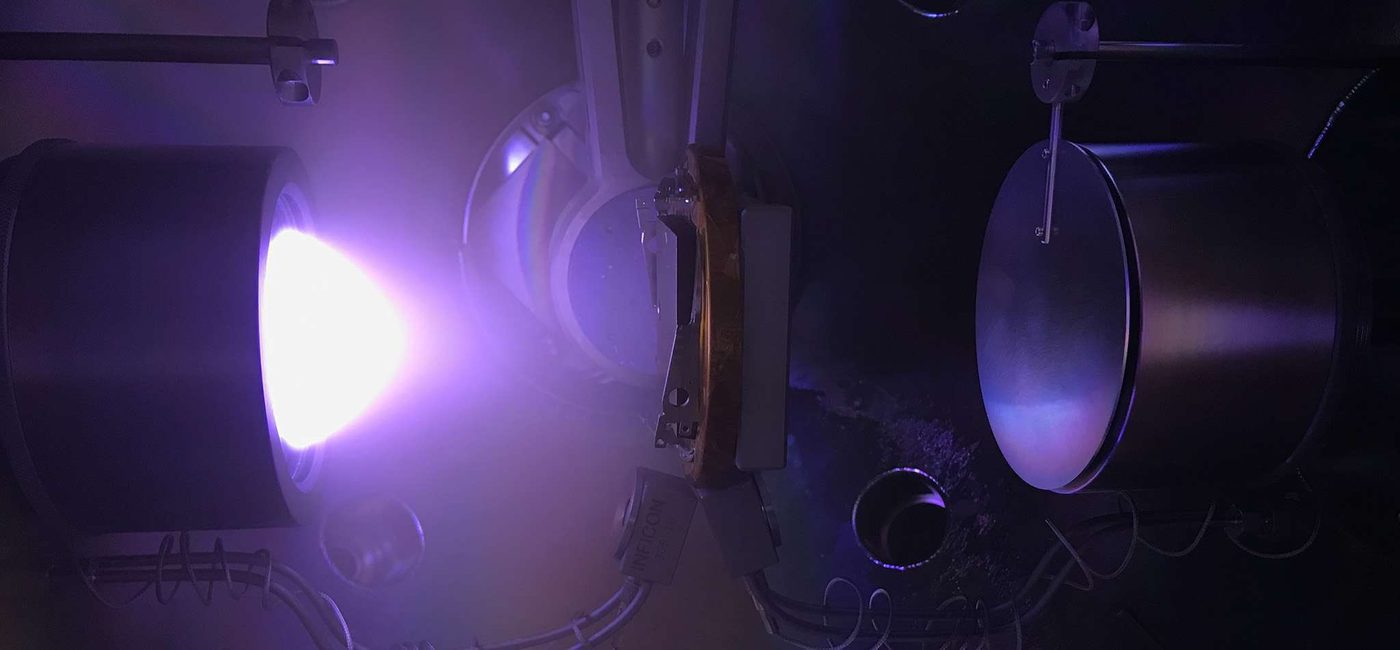
Lupine Research is an expert in thin-film deposition of metals and dielectrics tailored to your application. Using magnetron sputtering, we develop coatings that enhance the electrical, optical, chemical, and tribological properties of materials. When electroplating is not accurate enough, PVD is often the right alternative.
How Magnetron Sputtering Works
- Plasma formation — a vacuum chamber is filled with low-pressure inert gas (typically argon), and high voltage ionizes the gas between the target and the substrate.
- Ion bombardment — positively charged ions accelerate toward the negatively charged target, ejecting atoms of target material from its surface.
- Film deposition — sputtered material travels through the chamber and condenses onto the substrate as a thin film.
- The magnetron advantage — magnets behind the target trap electrons near its surface, intensifying plasma ionization and boosting sputtering efficiency.
Key Advantages
- Low process temperatures — deposit onto heat-sensitive substrates
- Uniform films — excellent consistency across the substrate
- Broad material compatibility — metals, alloys, and ceramics
- Precise control — fine-tuned thickness and composition
Applications
Magnetron sputtering serves electronics, semiconductors, optics, medical devices, aerospace, solar energy, hard coatings, energy storage, and nanotechnology.